Introduction
If you’ve ever taken a home loan and walked out with an insurance policy you didn’t fully understand, you’re not alone — and you’re not wrong to feel like something was off.
- Introduction
- The Direct Answer: What the RBI Home Loan Insurance Bundling Rules Actually Change
- Why This Rule Exists — And Why It’s Overdue
- What Exactly Is Banned Now
- 1. No More “Buy Our Insurance or No Loan”
- 2. No More Loan-Funded Premiums Without Consent
- 3. Explicit, Product-Specific Consent Required
- 4. A Defined, Enforceable Meaning of Mis-Selling
- 5. Refund and Compensation, Not Just a Warning
- 6. Suitability Assessment Before Complex Products
- 7. Dark Patterns Are Explicitly Banned
- Bank-Bundled Insurance vs Independently Chosen Term Insurance
- Decreasing Term Insurance: The Product Most Borrowers Never Get Offered
- What This Means for Business Owners and HNIs With Large Loans
- What This Means for NRIs
- Top 10 Mistakes Borrowers Make With Loan-Linked Insurance
- Myth vs Reality
- FAQs
- 1. What are the new RBI home loan insurance bundling rules?
- 2. Can a bank still ask me to buy insurance for my home loan?
- 3. What happens if I was already sold a bundled insurance policy with my loan?
- 4. Is a bank-bundled insurance policy usually a bad deal?
- 5. What type of insurance is best to protect a home loan?
- 6. Can banks fund my insurance premium through my own loan?
- 7. Do these rules apply to all banks?
- 8. When do the RBI mis-selling rules for banks take effect?
- 9. Should NRIs with Indian home loans be concerned about this issue too?
- 10. How do I know if my loan-linked insurance was mis-sold?
- Why I’m Reviewing This With Clients Now, Not in 2027
- Conclusion
- Let’s Review Your Loan-Linked Insurance Before It Costs You
- Do you Want to Read: Group Health Insurance vs Individual: 7 Costly Gaps
- off, especially for you
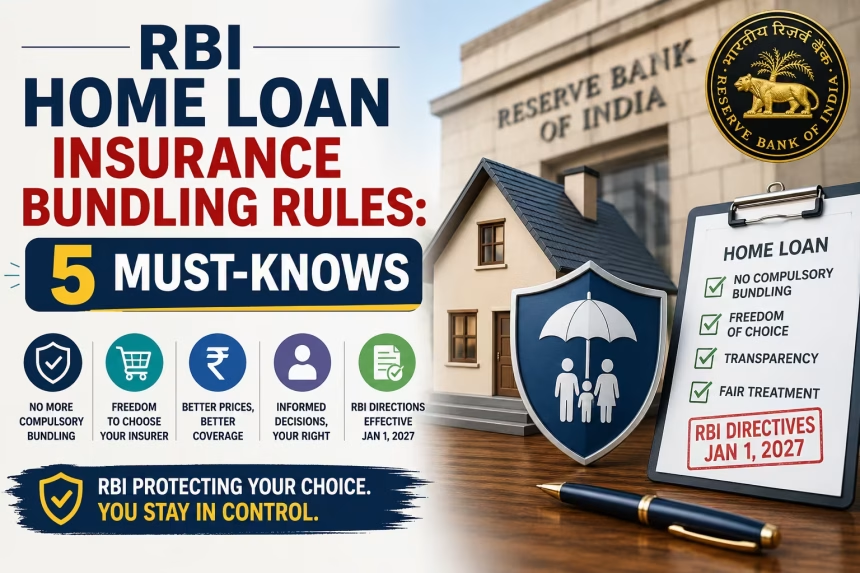
Finance Minister Nirmala Sitharaman herself has raised the question directly: if a home loan is already secured by the house itself, why is an unwarranted insurance policy being forced on customers as part of the loan process?On June 15, 2026, the RBI responded with the Responsible Business Conduct (Second Amendment) Directions, 2026, which explicitly prohibit banks from compulsory bundling of any third-party product or service with their own products, effective January 1, 2027.
This is genuinely one of the most consumer-favourable regulatory changes in recent memory — and it directly affects almost every high-income professional, business owner, and NRI who has ever taken, or plans to take, a large home loan in India.
The RBI home loan insurance bundling rules don’t just ban a shady sales practice. They open the door for you to buy the right protection product, from the right insurer, at the right price — instead of whatever your loan officer’s incentive structure pushed you toward.
The Direct Answer: What the RBI Home Loan Insurance Bundling Rules Actually Change
The RBI home loan insurance bundling rules, effective January 1, 2027, stop banks from making a home loan conditional on buying their in-house or partner insurance policy. If insurance is genuinely needed as a risk mitigant, you must be allowed to buy it from any provider you choose — and banks can no longer fund that premium through your own loan without your explicit consent.
Why This Rule Exists — And Why It’s Overdue
The practice being addressed is straightforward: banks made insurance appear to be a near-default part of the home loan process, and when a borrower doesn’t fully understand what extra protection the policy actually offers, that stops being advice and starts being mis-selling.
A revealing data point from the regulator’s own review: SBI’s bancassurance revenue jumped nearly 6x over the last decade to ₹2,766 crore, while its total interest income only doubled over the same period. That gap tells you where the real growth incentive was sitting — not in getting you a good insurance product, but in generating fee income from selling one.
A recurring pattern in complaint data describes insurance being presented as a required or implied condition of a loan, rather than a separate, optional purchase — and separately, endowment or insurance-cum-investment products have been marketed as simple one-time investments, obscuring that they carry ongoing premium obligations and mortality charges that eat into returns, disproportionately so for older borrowers since mortality charges rise with age.
Real-life situation: A 42-year-old business owner takes a ₹1.5 crore home loan. The bank’s relationship manager mentions “mandatory loan protection insurance,” bundles in a 20-year endowment-style policy costing ₹1.8 lakh a year, and — this is the part that should alarm you — in many cases, banks even issue fresh loans to finance such policies, putting the customer into an endless loop of debt just to pay for insurance they never asked to compare.
What Exactly Is Banned Now
RBI defines compulsory bundling as the practice of making availment of one product or service conditional upon availment of another product or service, whether the bank’s own or a third party’s.
Here’s what changes for you as a borrower from January 1, 2027:
1. No More “Buy Our Insurance or No Loan”
If a third-party product is genuinely required as a risk mitigant for the loan, you must be given the choice to purchase it from any provider — not just the bank’s preferred partner.
2. No More Loan-Funded Premiums Without Consent
Banks cannot fund the purchase of any product — their own or a third party’s — out of your sanctioned loan facility without your explicit consent.
3. Explicit, Product-Specific Consent Required
Consent must now be explicit, recorded, and specific to each product — and on digital platforms, the default option must be set to “No,” so you’re never opted in by default.
4. A Defined, Enforceable Meaning of Mis-Selling
For the first time, RBI has clearly defined mis-selling: selling a product that doesn’t align with your needs, giving incomplete or incorrect information, selling without explicit consent, or making one product mandatory for availing another.
5. Refund and Compensation, Not Just a Warning
If mis-selling is proven, the bank must refund the entire amount you paid for the product and compensate you for any losses incurred — and you can file a complaint within 30 days of receiving your signed agreement.
6. Suitability Assessment Before Complex Products
Before selling complex financial products, banks must now conduct a suitability assessment based on your age, income, financial understanding, and risk appetite.
7. Dark Patterns Are Explicitly Banned
RBI has banned 11 types of dark patterns used to influence customer behaviour on digital platforms, including false urgency, confirm shaming, forced action, subscription traps, and drip pricing.
Bank-Bundled Insurance vs Independently Chosen Term Insurance
This is the comparison that matters most once the bundling requirement disappears.
| Factor | Bank-Bundled Policy | Independently Chosen Term Insurance |
|---|---|---|
| Product type | Often endowment or credit-life, cost-heavy | Pure term, cost-efficient |
| Cover structuring | Fixed to loan amount, rarely revisited | Structured to your full income-replacement need |
| Premium funding | Sometimes loan-funded, compounding debt | Paid directly, no added debt |
| Insurer choice | Bank’s preferred partner only | Any insurer, compared on claim settlement ratio |
| Portability if you refinance/prepay | Often tied to the specific loan | Fully independent of the loan |
| Tax treatment | Same 80C/10(10D) rules apply if genuinely term/life insurance | Same 80C/10(10D) rules apply |
| Advisory support | Transactional, product-push oriented | Needs-based, ongoing review |
Expert insight: A home loan is a liability that needs protection — but the right tool is usually a term insurance policy (or a decreasing term/mortgage protection plan matched to your outstanding balance), not a 15–20 year endowment plan that quietly layers mortality charges and low investment returns into what should be a simple protection decision.
Decreasing Term Insurance: The Product Most Borrowers Never Get Offered
If your only goal is making sure your home loan doesn’t become your family’s burden, a decreasing term insurance or mortgage protection plan is usually a better structural fit than what banks typically bundle in.
- Cover reduces roughly in line with your outstanding loan balance over time
- Premiums are meaningfully lower than a level-cover term plan of the same initial sum assured
- It can be bought independently of the bank, from any insurer
- It doesn’t disappear or need re-purchasing if you refinance with a different lender
Common mistake: assuming the bank-sold policy IS your mortgage protection, when in many cases it’s a savings-linked product with a much smaller effective death benefit than a properly structured term plan would have provided for the same premium.
What This Means for Business Owners and HNIs With Large Loans
If you’ve taken a substantial loan against property, business expansion, or a commercial mortgage:
- Review whether your existing loan-linked insurance is genuinely proportionate to your outstanding liability, or was sized to maximise the bank’s commission
- From 2027 onward, you’ll have clear regulatory backing to insist on sourcing your own cover — but you can start this review now, before the rule even takes effect
- If your policy was loan-funded without clear consent, you may have grounds to raise this with your bank’s grievance mechanism even before January 2027, since suitability and consent principles are already being actively enforced by IRDAI in parallel
IRDAI itself reported 26,667 mis-selling complaints in FY25 alone, a 14% year-on-year increase, with an average remediation period of 87 days — so this isn’t a theoretical problem being solved preemptively; it’s a documented, growing pattern.
What This Means for NRIs
If you hold an Indian home loan while living abroad — common among NRIs investing in Indian property — the same bundling practices have applied to you, often with less opportunity to question the sales process during a remote loan approval.
- Once the rule takes effect, you’ll be entitled to the same explicit consent and provider-choice protections as resident borrowers
- In the interim, it’s worth reviewing any existing loan-linked policy to confirm it’s genuinely proportionate cover, not a high-commission product bundled during a rushed remote approval process
- Sourcing your own term or mortgage protection cover independently also gives you more control over FEMA-compliant premium payment structuring, versus a bank-administered product
Top 10 Mistakes Borrowers Make With Loan-Linked Insurance
- Assuming insurance is a mandatory part of every home loan — it isn’t, and soon can’t be forced as one.
- Never asking whether the “loan protection” policy is term insurance or a costlier endowment/investment-linked product.
- Allowing the bank to fund the insurance premium through the loan itself without realising the compounding interest cost.
- Not comparing the bank’s offered premium against an independently sourced term or mortgage protection plan.
- Assuming cover automatically decreases with the outstanding loan balance — many bundled policies don’t.
- Not reading whether consent was genuinely explicit and product-specific, versus buried in loan paperwork.
- Failing to file a mis-selling complaint within the applicable window when a policy clearly wasn’t explained properly.
- Believing the bank’s insurance partner is automatically the best-value option, without checking claim settlement ratios elsewhere.
- Not revisiting loan-linked insurance after a loan refinance or prepayment, leaving mismatched or unnecessary cover in place.
- Treating this RBI change as a 2027 problem, when reviewing existing loan-linked policies is worth doing now.
Myth vs Reality
| Myth | Reality |
|---|---|
| “Insurance is mandatory to get a home loan.” | Banks cannot make a loan conditional on buying insurance from them; if insurance is genuinely needed as a risk mitigant, you must be free to buy it from any provider. |
| “The bank’s insurance partner offers the best deal since they arranged it.” | Bank-bundled products are often priced and structured around commission economics, not necessarily the best cover-to-premium ratio available to you. |
| “If I signed the loan paperwork, I agreed to the insurance too.” | Consent must now be explicit and product-specific — broad loan paperwork consent doesn’t automatically cover a bundled insurance product. |
| “This rule only protects future borrowers, not people who already have a loan.” | While the rule takes effect January 2027, existing mis-selling complaints can already be raised through IRDAI and bank grievance mechanisms under current suitability principles. |
| “A loan-linked endowment policy also protects my family properly.” | It may provide some death benefit, but often at a much lower cover-to-premium efficiency than a dedicated term or mortgage protection plan would for the same cost. |
Who Should Review Their Position Now
Salaried professionals with a home loan: Check whether your loan-linked policy is term insurance or a costlier bundled product, and compare it against an independent quote.
Business owners with commercial or property-backed loans: Review whether cover is proportionate to your actual liability or was sized around commission incentives.
Doctors, CAs, lawyers with large mortgages: Your income level usually justifies properly structured term or mortgage protection cover, not a generic bank-bundled product.
NRIs with Indian property loans: Revisit any loan-linked policy bought during a remote approval process, where sales pressure and consent clarity may have been weaker.
Families relying on a single loan-linked policy: Confirm the cover amount genuinely matches your outstanding loan balance today, not what it was when the loan was first sanctioned.
Anyone refinancing or prepaying a loan soon: Use this moment to decouple your insurance decision from your loan decision entirely.
Actionable Checklist
- Pull out your existing home loan documents and confirm whether an insurance policy was bundled in
- Check if it’s term insurance, endowment, or an investment-linked product
- Confirm whether the premium was funded through the loan itself
- Compare the bundled policy’s cover-to-premium ratio against an independently sourced term or mortgage protection quote
- Verify the cover amount still matches your current outstanding loan balance
- If consent wasn’t clearly explicit, consider raising a mis-selling query with your bank or IRDAI
- For any new home loan from now on, explicitly ask whether insurance is being presented as mandatory
- Source your protection cover independently, matched to your actual liability, not the bank’s product shelf
FAQs
1. What are the new RBI home loan insurance bundling rules?
Effective January 1, 2027, RBI prohibits banks from making a home loan conditional on buying insurance from them, and requires explicit consent before funding any product through the loan itself.
2. Can a bank still ask me to buy insurance for my home loan?
Yes, if insurance is genuinely required as a risk mitigant, but you must be free to buy it from any provider of your choice, not just the bank’s partner.
3. What happens if I was already sold a bundled insurance policy with my loan?
You can raise a mis-selling complaint with your bank or IRDAI; if proven, the bank must refund the amount and compensate for any losses.
4. Is a bank-bundled insurance policy usually a bad deal?
Not always, but it’s often priced and structured around commission economics rather than the best cover-to-premium ratio available to you elsewhere.
5. What type of insurance is best to protect a home loan?
A term insurance policy or a decreasing term/mortgage protection plan matched to your outstanding loan balance is usually more cost-efficient than an endowment-style bundled product.
6. Can banks fund my insurance premium through my own loan?
Only with your explicit consent — RBI’s new rules prohibit banks from funding any product purchase through a sanctioned loan facility without clear, recorded consent.
7. Do these rules apply to all banks?
They apply to all commercial banks, excluding Small Finance Banks, Payments Banks, Regional Rural Banks, and Local Area Banks.
8. When do the RBI mis-selling rules for banks take effect?
January 1, 2027, giving banks roughly six and a half months from the June 2026 announcement to comply.
9. Should NRIs with Indian home loans be concerned about this issue too?
Yes — the same bundling practices have applied to NRI borrowers, often with less scrutiny during remote loan approvals, making an independent policy review worthwhile.
10. How do I know if my loan-linked insurance was mis-sold?
Signs include unclear or bundled consent, a product that doesn’t match your stated needs, or being told insurance was mandatory when it wasn’t genuinely required.
Why I’m Reviewing This With Clients Now, Not in 2027
In my experience advising business owners, professionals, and NRIs with significant home loans, the most common gap isn’t a missing policy — it’s a policy that was bundled in without a real comparison ever being offered. This regulatory change gives borrowers clear standing to ask for better, but reviewing your existing cover doesn’t need to wait until the rule takes effect.
Conclusion
The RBI home loan insurance bundling rules mark a genuine shift — from insurance being a quiet, near-mandatory add-on to a deliberate, compared, and consented-to decision. But the underlying principle was true even before this regulation existed: your home loan protection should be sized to your actual liability, sourced on merit, and reviewed independently of who’s selling it to you.
Waiting for January 2027 to review your existing loan-linked policy isn’t necessary. The best time to check whether you’re adequately and efficiently protected is now.
Let’s Review Your Loan-Linked Insurance Before It Costs You
Not sure whether your existing home loan insurance is genuinely proportionate, or whether an independent term or mortgage protection plan would serve you better?
Book a Zoom or phone consultation, from anywhere in the world, to:
- Review your existing loan-linked insurance policy
- Compare it against an independently structured term or mortgage protection plan
- Get a personalized recommendation matched to your actual liability
No physical meeting required — just your calendar and 30 minutes.