


Introduction: Is Mutual Funds Safe for Middle Class?
If you’re earning between ₹5 lakh and ₹30 lakh annually and wondering whether mutual funds are truly safe for your hard-earned money, you’re not alone. The Indian middle class has swelled to represent a significant portion of the country’s wealth creators, and mutual funds have become the go-to investment vehicle for this demographic. But the critical question remains: Are mutual funds safe for middle class investors?
- Introduction: Is Mutual Funds Safe for Middle Class?
- 1. The Middle Class in India: Who Are You & Why Mutual Funds Matter
- 2. The Mutual Fund Industry: A Story of Explosive Growth & Stability
- 3. SEBI’s Regulatory Framework: The Safety Net Protecting Your Investments
- A. The SEBI Mandate
- B. Key Regulations Protecting Middle-Class Investors
- C. Recent SEBI Reforms (2025-26) Enhancing Safety
- 4. How Mutual Funds Are Safe for Middle Class: The Investor Protection Mechanisms
- 5. Understanding Risks: The Complete Picture for Safe Mutual Fund Investing
- A. Market Risk
- B. Manager Risk
- C. Credit Risk (Debt Funds)
- D. Concentration/Sector Risk
- E. Liquidity Risk
- F. Inflation Risk
- 6. SIP vs. Lumpsum: Choosing the Safest Path for Middle-Class Investing
- 7. Choosing the Right Mutual Funds: A Practical Guide for Safe Middle-Class Investing
- A. Fund Category Selection Based on Risk Profile
- B. Key Metrics to Evaluate Before Investing
- C. Recommended Portfolio for Typical Middle-Class Investor
- 8. Taxation of Mutual Funds: Middle-Class Tax-Efficient Investing
- A. Equity Mutual Funds (FY 2025-26)
- B. Debt Mutual Funds (FY 2025-26)
- C. Special Tax Benefits for Middle Class
- D. Optimal Strategy for Middle-Class Tax Efficiency
- 9. Real-World Lessons: What Makes Mutual Funds Safe (And What Doesn’t)
- A. The Franklin Templeton Crisis (April 2020): What Went Wrong
- B. The Manipur Mutual Fund Scam (₹560 Crore Loss)
- C. Success Story: Middle-Class Crorepati Through SIP
- 10. How to Start: Your Step-by-Step Guide to Safe Mutual Fund Investing
- Step 1: Open a Demat Account (Optional but Recommended)
- Step 2: Assess Your Risk Profile
- Step 3: Choose Appropriate Fund(s)
- Step 4: Start Your SIP
- Step 5: Monitor Quarterly & Review Annually
- Step 6: Automate Everything
- 11. Angel One Demat Account: The Perfect Platform for Middle-Class Mutual Fund Investing
- Why Angel One for Middle-Class Investors?
- How to Integrate Angel One with Your Mutual Fund Strategy
- FAQs: Are Mutual Funds Safe for Middle Class?
- Q1: Are mutual funds guaranteed to provide returns?
- Q2: Can I lose all my money in mutual funds?
- Q3: What happens if the mutual fund company goes bankrupt?
- Q4: Is SIP safer than lumpsum investing?
- Q5: Should I invest in direct plan or regular plan mutual funds?
- Q6: How much should I invest in mutual funds?
- Q7: Can mutual fund investments be attached/seized?
- Q8: How do I report mutual fund income in income tax returns?
- Q9: What’s the best mutual fund for middle-class long-term investing?
- Q10: Can I redeem mutual funds anytime?
- Conclusion: Building Your Financial Future Through Safe Mutual Fund Investing
- Don’t Miss: 80% लोग SIP गलत तरीके से करते हैं! | SIP का पूरा सच with Data Proof | SIP Investment Strategy to Grow Your Money
- off, especially for you
The straightforward answer is yes—mutual funds are exceptionally safe for middle-class Indians when chosen wisely and aligned with your financial goals. However, this safety doesn’t happen by accident. It’s backed by robust regulatory oversight, decades of proven performance, and investor-centric protections that have been strengthened significantly. In this comprehensive guide, we’ll explore why mutual funds have become the safest wealth-building tool for India’s middle class, backed by real data, regulatory frameworks, and practical investment strategies.


1. The Middle Class in India: Who Are You & Why Mutual Funds Matter
To understand if mutual funds are safe for the middle class, we first need to define who comprises India’s middle class. According to the People Research on India’s Consumer Economy (PRICE), the middle-income class household earns an annual income of ₹5 lakhs to ₹30 lakhs (at 2020-21 prices). This represents economically secure households with minimal risk of falling into poverty or vulnerability.
The 2025 Union Budget reinforced the middle class’s importance by extending the nil tax slab to ₹12 lakh, acknowledging the need for financial support among this crucial demographic. As of now, India’s middle class comprises approximately 31% of the population, projected to grow to 60% by 2047.
For this segment, mutual funds offer something traditional investment vehicles like fixed deposits cannot: the potential to build substantial wealth through disciplined investing while enjoying regulatory protection. With inflation eroding purchasing power at rates of 6-7% annually, parking money in low-return instruments has become economically risky. This is where mutual funds step in as the ideal solution for middle-class wealth creation.
2. The Mutual Fund Industry: A Story of Explosive Growth & Stability
The Indian mutual fund industry has experienced unprecedented growth, transforming from a niche investment avenue to a mainstream wealth-building platform. Understanding this growth trajectory reinforces why mutual funds are safe for middle class.
Key Industry Milestones:
- AUM Reached ₹81 Trillion (October-December 2025): The industry managed an average AUM of ₹81 trillion, representing 18% year-on-year growth.
- SIP Inflows Hit Record Highs: May 2025 witnessed the highest-ever SIP inflows of ₹26,688 crore, demonstrating sustained retail participation.
- Equity Funds Quadrupled: Open-ended equity fund AUM jumped from ₹9 trillion (November 2020) to ₹36 trillion (November 2025)—a remarkable 4x increase.
- Projected Future Growth: The industry is expected to surpass ₹300 trillion AUM by 2035.
This explosive growth isn’t occurring in a regulatory vacuum. It’s happening because SEBI (Securities and Exchange Board of India)—India’s financial markets watchdog—ensures every transaction, disclosure, and fund operation adheres to stringent standards.
[Image: image:73 – SIP systematic investment plan growth chart]
3. SEBI’s Regulatory Framework: The Safety Net Protecting Your Investments
When asking “Are mutual funds safe for middle class?”, the most important answer lies in understanding the regulatory architecture. SEBI acts as the guarantor of your investment safety through a comprehensive regulatory framework.
A. The SEBI Mandate
SEBI operates under the SEBI Act, 1992, with specific powers to:
- Formulate and enforce regulations for all market participants
- Register and oversee intermediaries (fund houses, brokers, portfolio managers)
- Mandate disclosure and transparency requirements
- Enforce penalties and corrective actions against violations
- Establish and manage the Investor Protection Fund (IPF)
B. Key Regulations Protecting Middle-Class Investors
SEBI (Mutual Funds) Regulations 1996 (Amended March 2025)
This foundational regulation ensures mutual funds are safe for middle class through:
- Three-Tier Structure: Every mutual fund operates with a clear hierarchy:
- Sponsor: Initiates the fund (like HDFC, ICICI, SBI)
- Trustee: Guards investor interests (independent entity)
- AMC (Asset Management Company): Manages investments
- Mandatory Registrations: All mutual funds must register with SEBI before accepting investor money.
- Scheme Information Documents (SID): Every mutual fund scheme must provide transparent documentation outlining investment objectives, risks, fees, and holdings.
- Portfolio Disclosures: Fund houses must publicly disclose their holdings regularly, enabling investors to understand exactly where their money is deployed.
C. Recent SEBI Reforms (2025-26) Enhancing Safety
Recent reforms specifically strengthen protections for middle-class investors:
Exit Load Reduction (September 2025)
- Maximum permissible exit load capped at 3% (reduced from 5%)
- Most funds currently charge 1-2%, well below the cap
- Relief particularly beneficial for middle-class redemptions
Stricter Expense Ratio Oversight
- Total Expense Ratio (TER) transparency mandated
- Brokerage limits: Capped at 2 bps (cash), 1 bps (derivatives)
- AMCs must eliminate hidden charges
Gender Inclusion Incentives
- Special commissions for onboarding first-time women investors
- Reflects SEBI’s commitment to inclusive wealth creation
Enhanced Fraud Detection
- AMCs required to implement internal fraud detection mechanisms
- Tech-driven surveillance and regular audits mandatory
- Staff training on ethical practices
Investor Protection Fund (IPF)
- SEBI established IPF to compensate investors in case of broker defaults
- Provides additional safety net beyond fund valuations
4. How Mutual Funds Are Safe for Middle Class: The Investor Protection Mechanisms
Safety in mutual funds for middle-class investors operates on multiple levels:
A. No Market Credit Risk
Unlike direct stock investing where you bear company default risk, mutual funds distribute this risk across hundreds of securities. A mutual fund with 50-100 holdings means that even if 2-3 holdings face challenges, your portfolio survives with minimal impact.
B. Daily NAV Pricing
Your mutual fund investment is valued daily at Net Asset Value (NAV), determined by:
- (Total Assets – Total Liabilities) / Number of Units Outstanding
This daily valuation ensures:
- Transparency about your investment’s actual worth
- No black-box valuations that occur with real estate or private holdings
- Fair entry and exit pricing at current market rates
C. Segregated Custody
Mutual fund assets are held by independent custodians (usually banks or depositories), not by the AMC. This segregation means:
- Your money cannot be used for the fund house’s business operations
- Even if an AMC faces financial difficulty, your assets remain protected
- Custodians are regulated separately by SEBI
D. Professional Management
Your money is managed by experienced fund managers with:
- Specialized degrees (MBA, CFA, etc.)
- Years of market experience
- Defined investment mandates
- Performance-based accountability
This contrasts sharply with individual investor mistakes common in direct stock investing.
5. Understanding Risks: The Complete Picture for Safe Mutual Fund Investing
While mutual funds are safe for middle class, no investment is risk-free. Understanding these risks helps you make informed decisions:
A. Market Risk
- Definition: Securities held by the fund may decline in value
- For Middle Class: Mitigated through long-term investing and diversification
- SIP Advantage: Rupee cost averaging reduces impact
B. Manager Risk
- Definition: Active fund managers may fail to execute strategy effectively
- Mitigation: Choose funds with consistent long-term track records; consider passive/index funds
C. Credit Risk (Debt Funds)
- Definition: Bonds held may default (issuer fails to pay)
- Example: Franklin Templeton’s 2020 debt fund closures (₹26,000 crore)
- Mitigation: Invest in debt funds holding AAA-rated bonds; avoid credit risk funds
D. Concentration/Sector Risk
- Definition: Heavy exposure to one sector during downturns
- Solution: Diversify across large-cap, mid-cap, and balanced funds
E. Liquidity Risk
- Definition: Inability to sell holdings at fair prices (rare in open-ended funds)
- Reassurance: Open-ended mutual funds are highly liquid; you can redeem anytime at NAV
F. Inflation Risk
- Definition: Returns don’t outpace cost-of-living increases
- Solution: Invest in equity mutual funds for long-term; inflation-adjusted returns typically average 10-12% annually
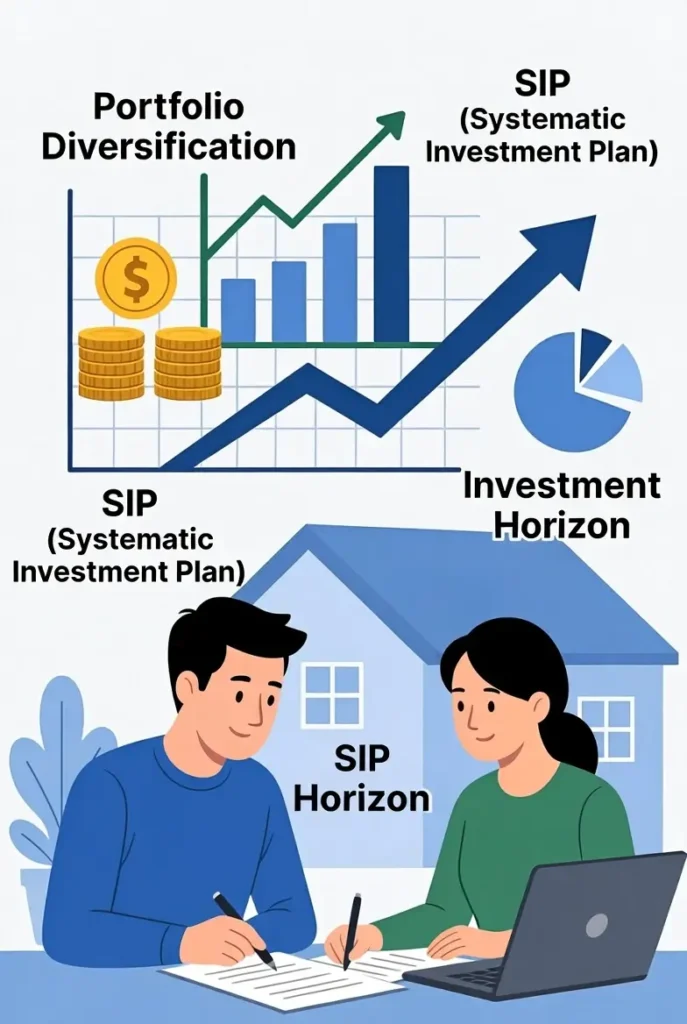
6. SIP vs. Lumpsum: Choosing the Safest Path for Middle-Class Investing
The safety of mutual fund investing for middle class is significantly enhanced by choosing the right investment method: SIP (Systematic Investment Plan) or Lumpsum.
A. SIP: The Middle-Class Favorite
How It Works: Investing a fixed amount (₹500-₹100,000+) at regular intervals (monthly/weekly/quarterly)
Why SIP Is Safer for Middle Class:
- Rupee Cost Averaging (RCA)
- You buy more units when prices are low, fewer when prices are high
- Smooths out the impact of market volatility
- Eliminates “timing the market” pressure
- Example: ₹5,000 monthly over 10 years at 12% returns = ₹11 lakhs
- Behavioral Discipline
- Automated debit prevents emotional decision-making
- Forces consistent saving habits
- Reduces impact of market fear and greed
- Accessibility
- Minimum investment just ₹500
- Suitable for middle-class monthly income patterns
- No lump sum capital requirement
- Flexibility
- Pause or resume anytime without penalties
- Adjust amount as income increases
- Modify funds if strategy changes
SIP Performance: Mid-cap funds have delivered 20.74% average returns over 5 years through SIP investing.
B. Lumpsum: When It Makes Sense
Best For:
- Receiving bonuses or inheritance
- When markets are undervalued (timing advantage)
- Surplus funds that need deployment
Risk Factor: Requires accurate market timing ability—most middle-class investors lack this skill.
C. Hybrid Approach
The safest strategy for middle class combines both:
- 70% in SIP: Regular monthly investing for long-term wealth
- 30% in Lumpsum: Deployed during market corrections
This balanced approach captures SIP’s safety while leveraging occasional lumpsum opportunities.
Recommended SIP Amount for Middle Class:
- Conservative: 5-10% of monthly income (₹500-₹2,000)
- Moderate: 10-15% of monthly income (₹2,000-₹5,000)
- Aggressive: 15-25% of monthly income (₹5,000-₹10,000)
7. Choosing the Right Mutual Funds: A Practical Guide for Safe Middle-Class Investing
The safety of mutual funds for middle class also depends on selecting appropriate schemes. Here’s a practical framework:
A. Fund Category Selection Based on Risk Profile
Conservative Middle-Class Investor (Low Risk Tolerance)
- Ideal Funds: Liquid funds, debt funds, balanced hybrid funds
- Expected Returns: 5-8% annually
- Why It’s Safe: Minimal equity exposure, predictable returns
- Best Use: Emergency funds, short-term goals (1-3 years)
Moderate Middle-Class Investor (Medium Risk Tolerance)
- Ideal Funds: Balanced hybrid funds, flexi-cap funds, large-cap funds
- Expected Returns: 8-12% annually
- Why It’s Safe: Mix of equities and debt provides cushion
- Best Use: Medium-term goals (3-7 years), education funds
Growth-Oriented Middle-Class Investor (Higher Risk Tolerance)
- Ideal Funds: Mid-cap funds, multi-cap funds, small-cap funds
- Expected Returns: 12-18%+ annually (higher volatility)
- Why It’s Safe: Long-time horizon allows recovery from downturns
- Best Use: Retirement (10+ years), wealth creation
Performance Benchmarks (Real Data):
- Large-cap funds: ~15% average (3-5 year returns)
- Mid-cap funds: 20.74% average (5-year returns)
- Small-cap funds: 24.91% CAGR (5-year returns)
- Balanced funds: 13-15% average (moderate volatility)
B. Key Metrics to Evaluate Before Investing
- Fund House Reputation
- Top performers: SBI, HDFC, ICICI Prudential, Nippon India
- Check SEBI registration and track record
- Fund Manager Experience
- Minimum 10+ years managing similar fund type
- Consistent team reduces manager risk
- Expense Ratio (Total Expense Ratio – TER)
- Direct plans: 0.5-1% annually
- Regular plans: 1-2% annually
- Lower is better; avoid funds exceeding 2.5%
- Assets Under Management (AUM)
- Funds with ₹500 crore+ AUM indicate credibility
- Very new funds (<₹100 crore) carry higher risk
- 3-Year, 5-Year, 10-Year Returns
- Compare against category benchmarks
- Consistent outperformance indicates strong management
- One-year returns can be misleading
- SEBI Riskometer
- Every fund displays a risk rating: Low → Very High
- Match fund’s risk level with your comfort zone
C. Recommended Portfolio for Typical Middle-Class Investor
Allocation Strategy (Age 35, 25-Year Horizon):
| Fund Type | Allocation | Specific Example | Expected Return |
|---|---|---|---|
| Large-Cap Equity | 40% | HDFC Top 100/SBI Blue Chip | 12-14% |
| Mid-Cap Equity | 30% | HDFC Mid Cap/Motilal Oswal Midcap | 16-20% |
| Balanced/Hybrid | 20% | Balanced Advantage/Hybrid funds | 10-12% |
| Debt/Liquid | 10% | Debt funds/Liquid funds | 6-7% |
Expected Overall Portfolio Return: 12-14% (market-dependent)
8. Taxation of Mutual Funds: Middle-Class Tax-Efficient Investing
Understanding taxation ensures mutual funds are safe AND tax-efficient for middle class.
A. Equity Mutual Funds (FY 2025-26)
Short-Term Capital Gains (Held ≤12 months):
- Tax Rate: 20% + surcharge + 4% health cess
- On ₹1 lakh profit: Pay ₹20,000 tax
Long-Term Capital Gains (Held >12 months):
- Tax Rate: 12.5% on gains exceeding ₹1.25 lakh per financial year
- First ₹1.25 lakh gain: 0% tax (annual exemption)
- On ₹2 lakh profit: Pay (75,000 × 12.5%) = ₹9,375 tax
Impact: Holding equity funds beyond 12 months reduces tax by approximately 37.5%.
B. Debt Mutual Funds (FY 2025-26)
Short-Term (Held ≤24 months):
- Taxed at investor’s income tax slab rate (0%-30%)
- For middle-class (20% bracket): 20% tax rate
Long-Term (Held >24 months):
- Tax Rate: 12.5% with indexation benefit
- Indexation reduces taxable gain significantly
- Highly tax-efficient for 3-5 year holding periods
C. Special Tax Benefits for Middle Class
ELSS Funds (Equity-Linked Savings Scheme)
- Tax deduction under Section 80C: Up to ₹1.5 lakh investment
- Tax saving for middle-class (20% bracket): ₹30,000 annually
- 3-year lock-in period
- LTCG tax applies post lock-in period
Dividend Taxation
- Dividend income taxed at your income slab rate
- 10% TDS automatically deducted if annual dividend ≥ ₹5,000 per fund house
- Claim refund if TDS exceeds your actual tax liability
D. Optimal Strategy for Middle-Class Tax Efficiency
- Equity funds for 12+ months (leverages LTCG benefits)
- ELSS for tax-saving portion (Section 80C deduction)
- Debt funds for short-term goals (hold 3+ years for indexation)
- Avoid frequent trading (generates short-term gains taxed at 20%)
- Direct Plans over Regular Plans (lower expense ratios = better after-tax returns)
Tax Savings Example for ₹50,000 Annual SIP:
- Invested in ELSS: ₹50,000 × 20% (tax bracket) = ₹10,000 tax saved annually
- Over 10 years: ₹1 lakh tax saved
- Plus LTCG exemption on gains
9. Real-World Lessons: What Makes Mutual Funds Safe (And What Doesn’t)
Learning from mistakes and successes strengthens confidence that mutual funds are safe for middle class.
A. The Franklin Templeton Crisis (April 2020): What Went Wrong
What Happened:
- Franklin Templeton abruptly closed 6 debt mutual fund schemes
- Combined AUM: ₹26,000 crore affected
- Investors faced liquidity crisis and delayed redemptions
Root Causes:
- Credit Risk Concentration: 80% portfolio in AA-rated or lower bonds (risky)
- Undiverse Holdings: Heavy exposure to defaulting companies (IL&FS, Sintex, Yes Bank)
- Poor Risk Management: Fund managers didn’t diversify adequately
Lessons for Middle-Class Investors:
- ✅ Invest in debt funds with AAA-rated portfolios only
- ✅ Check fund manager’s credit quality standards
- ❌ Avoid “credit risk” or “high-yield” debt funds
- ✅ Choose funds from established, regulated AMCs
Resolution: Government intervened with ₹50,000 crore RBI liquidity facility; investors eventually recovered money.
B. The Manipur Mutual Fund Scam (₹560 Crore Loss)
What Happened:
- Unregulated deposit schemes (NOT mutual funds) promised 5% monthly returns
- Trapped 48+ lakh investors’ lifetime savings
- Enforcement Directorate investigated massive fraud
Key Insight: Schemes promising fixed, guaranteed high returns are red flags—they’re likely unregulated and fraudulent.
Difference from Regulated Mutual Funds:
- Regulated mutual funds: NAV-based, no guaranteed returns
- Unregulated schemes: Promise fixed returns (obvious fraud)
- SEBI mutual funds: Transparent, regulated, audited daily
Lesson: Only invest through SEBI-registered platforms (like Angel One for mutual funds).
C. Success Story: Middle-Class Crorepati Through SIP
Scenario:
- 30-year-old middle-class professional (₹8 lakh annual income)
- Invests ₹5,000 monthly via SIP in balanced mutual fund
- 12% average annual return, consistent for 25 years
Results:
- Total invested: ₹15 lakh
- Final corpus: ₹58.5 lakh
- Wealth created: ₹43.5 lakh (289% return)
- Status: Achieved millionaire goals through disciplined SIP investing
10. How to Start: Your Step-by-Step Guide to Safe Mutual Fund Investing
The safety of mutual funds for middle class begins with proper execution. Here’s your action plan:
Step 1: Open a Demat Account (Optional but Recommended)
Why? A demat account consolidates your mutual fund, stock, and other holdings in one place.
For Middle-Class Investors:
- Best Option: Angel One Demat Account
- Key Benefits:
- Zero balance account opening (no minimum)
- Free first year (₹240 annually after)
- Access to 5000+ mutual fund schemes
- SIP facility (including stock SIP)
- Real-time portfolio tracking
- Integrated research and recommendations
- Seamless redemption to bank account
Process:
- Download Angel One app
- Complete e-KYC (online verification)
- Link bank account
- Receive approval within 24-48 hours
Step 2: Assess Your Risk Profile
Answer these questions:
- How many years until you need the money? (Time Horizon)
- Can you tolerate 20%+ temporary portfolio decline? (Risk Tolerance)
- What’s your annual income and savings capacity?
- What specific goal are you investing for?
Step 3: Choose Appropriate Fund(s)
Based on Step 2:
- Long-term (10+years): 60% equity, 40% debt
- Medium-term (5-10 years): 50% equity, 50% debt
- Short-term (1-5 years): 30% equity, 70% debt
Step 4: Start Your SIP
Recommended SIP Amount: 10% of monthly income
- Middle-class income ₹50,000/month → Start with ₹5,000 SIP
- As income increases, boost SIP by 10-20% annually
Step 5: Monitor Quarterly & Review Annually
- Don’t obsess over daily NAV changes
- Review actual vs. expected returns every 12 months
- Rebalance portfolio every 2 years
- Increase SIP amount when you get salary hikes
Step 6: Automate Everything
- Set up automatic SIP debit from bank account
- Enable auto-dividend reinvestment for compounding
- Mark calendar for annual portfolio review
11. Angel One Demat Account: The Perfect Platform for Middle-Class Mutual Fund Investing
For middle-class Indians specifically asking “Are mutual funds safe for me?”, having the right platform matters significantly.
Why Angel One for Middle-Class Investors?
Comprehensive Investment Ecosystem:
- Mutual Funds: Access 5000+ schemes across all categories
- Stock Investing: Direct equity investing with zero annual charges first year
- SIP Flexibility: Monthly SIP starting ₹100 with auto-debit
- Stock SIP: Unique feature—create diversified stock baskets via SIP
Cost Transparency (Middle-Class Friendly):
- No account opening charges
- Zero balance account (no minimum)
- AMC: Free first year, ₹240 annually
- No exit load or maintenance charges for mutual funds
- Brokerage only on stock transactions (industry-standard rates)
Safety & Security:
- Multi-level authentication (2FA, encrypted login)
- Real-time transaction tracking
- Secure custodial arrangement
- SEBI-regulated platform
Educational Support:
- Research recommendations from expert team
- Mutual fund screener with multiple filters
- Live market insights and analysis
- Webinars and tutorials for beginners
Integration Benefits:
- Single account for stocks + mutual funds
- Unified portfolio tracking
- Simplified tax documentation (consolidated statements)
- One-click fund transfers between securities
How to Integrate Angel One with Your Mutual Fund Strategy
Scenario for Typical Middle-Class Investor:
Annual Income: ₹10 lakh
Monthly Savings Capacity: ₹8,000
Investment Strategy via Angel One:
- Mutual Fund SIP: ₹5,000/month
- ₹3,000 in large-cap balance fund
- ₹2,000 in mid-cap equity fund
- Direct Stock Investment: ₹1,500/month via Stock SIP
- Invest in 5 blue-chip dividend stocks
- ₹300 per stock for value accumulation
- Debt/Liquid Funds: ₹1,500/month
- Short-term safety and emergency corpus
Total Monthly Investment: ₹8,000
Annual Investment: ₹96,000
10-Year Projected Corpus (12% avg return): ₹15+ lakh
This integrated approach provides:
- Diversity (mutual funds + stocks)
- Safety (regulated SEBI platform)
- Flexibility (pause/resume anytime)
- Tax efficiency (Angel One provides detailed reports)
FAQs: Are Mutual Funds Safe for Middle Class?
Q1: Are mutual funds guaranteed to provide returns?
No. Mutual funds are market-linked investments. Returns depend on market performance and fund management. However, long-term equity fund returns average 12-15% annually historically—much better than inflation.
Q2: Can I lose all my money in mutual funds?
In extreme scenarios with illiquid debt funds (Franklin Templeton), investors faced delays but recovered money. With properly diversified equity funds and SEBI oversight, complete loss is virtually impossible for open-ended funds.
Q3: What happens if the mutual fund company goes bankrupt?
Your money is protected because assets are held in segregated custody (banks/depositories), not in the AMC’s name. Even if an AMC fails, your units remain yours. The Investor Protection Fund (IPF) provides additional compensation.
Q4: Is SIP safer than lumpsum investing?
SIP is generally safer for middle-class investors because rupee cost averaging mitigates market timing risks. Lumpsum works if you can time markets perfectly—most middle-class investors can’t.
Q5: Should I invest in direct plan or regular plan mutual funds?
Direct plans are better for middle class. Lower expense ratios (0.5-1%) vs. regular (1-2%) save ₹500-₹1,000 annually on ₹5 lakh investment. Use Angel One or direct fund house websites for direct plan access.
Q6: How much should I invest in mutual funds?
Start with 10% of monthly income via SIP. If ₹50,000/month income, start ₹5,000 SIP. As income grows, increase to 15-20% of income.
Q7: Can mutual fund investments be attached/seized?
No. Mutual fund units are securities held in demat form. Unlike physical assets, they cannot be easily attached for debt recovery without legal proceedings.
Q8: How do I report mutual fund income in income tax returns?
Angel One and other platforms provide detailed statements. Report capital gains/dividends in ITR Schedule 112A (equity funds) or Schedule S (debt funds). SEBI provides guides for filing.
Q9: What’s the best mutual fund for middle-class long-term investing?
Balanced/hybrid funds or large-cap + mid-cap combination (60% equity, 40% debt). Top performers: HDFC Balanced Advantage, SBI Balanced Advantage, Parag Parikh Flexi-cap.
Q10: Can I redeem mutual funds anytime?
Yes, open-ended funds allow redemption anytime at NAV. No lock-in period except ELSS (3 years). Processing typically takes 1-3 business days for funds to reach your bank account.
Conclusion: Building Your Financial Future Through Safe Mutual Fund Investing
The answer to “Are mutual funds safe for the middle class?” is a resounding yes—but with caveats. Your safety depends on:
- ✅ Choosing SEBI-regulated mutual funds through platforms like Angel One
- ✅ Starting with SIP investing for rupee cost averaging and discipline
- ✅ Diversifying across fund categories based on your risk profile
- ✅ Understanding taxation to maximize after-tax returns
- ✅ Having a long-term horizon (7-10 years minimum for equity)
- ✅ Monitoring periodically but avoiding emotional decision-making
India’s middle class has finally found a vehicle that combines accessibility (invest from ₹100), safety (SEBI oversight and regulatory protections), transparency (daily NAV pricing), and growth potential (12-15% historical returns).
For the salaried professional, entrepreneur, or freelancer earning ₹5-30 lakh annually, mutual funds represent the most practical path to achieving financial goals: children’s education, home purchase, retirement security, and generational wealth creation.
The middle-class family that starts a ₹5,000 monthly SIP today and remains invested for 20 years will accumulate over ₹25 lakh—a substantial corpus created through disciplined investing and market-driven compounding. That’s not just safe; it’s powerful.
Your financial future is built one SIP installment at a time. Start today with Angel One, and watch your wealth grow systematically, safely, and securely.